

-

Low Starting Quantity
-

Digital Proof Included
-

Design Support Available
-
In-House Production
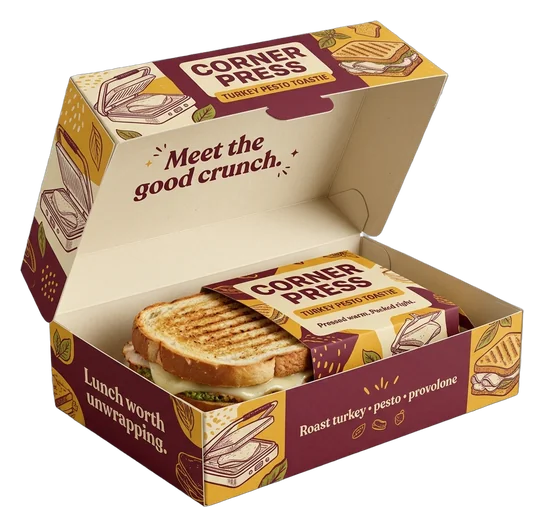
Give every sandwich a box that looks considered at the counter, carries your identity through pickup or takeaway, and opens with the food presented as intended. When a sandwich is chosen or handed over quickly, the box has little time to communicate appetite, order and brand character. Custom sizing and structure create a neater fit, while coordinated color, typography and panel design make the pack easier to connect with your business. Across the counter, pickup shelf or delivery handoff, that consistency can make a single order feel like part of a recognizable food experience. We build custom sandwich boxes around the way you serve, from compact tuck-end cartons to auto-bottom, windowed or gable formats where the approved specification suits the product. The goal is a box that supports handling, presents the sandwich with care and gives your brand a composed, professional presence when customers receive it. That result is developed as one connected system: the fit follows the packed sandwich, the material establishes the right physical character, printed panels organize brand and menu cues, and the opening keeps the experience coherent. Artwork checking, dieline support and a digital proof then help turn the chosen direction into a production-ready box, with material, coating and food-contact details confirmed for the intended use.

Get Custom Quote
FORMATS FOR THE WAY YOU SERVE
Choose a Box Route That Fits the Handoff
A sandwich sold across a counter does not need the same structure as a boxed meal, a pickup order or a multi-part meal pack. The right format should follow the packed sandwich, any wrap or liner, the number of components and the way the customer will open and carry the order. Tuck-end, auto-bottom, windowed and gable routes each create a different balance of fit, visible branding and first access. Choose the structure that keeps the order composed while giving your brand the right amount of presence for the service moment.

➜
Tuck-End Sandwich Boxes
A straight or reverse tuck-end format gives single sandwiches a compact carton with broad printable panels and a direct opening route for counter service, pickup or takeaway.
- Single-sandwich configuration
- Custom fit and panel layout
- Exterior and interior printing
- Direct tuck-end access
A focused choice for a neat handoff and a clearly branded single-item order.
Customize Now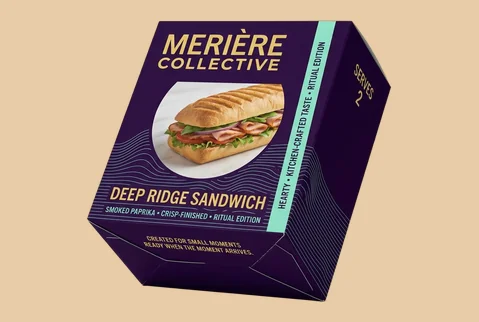
➜
Auto-Bottom Sandwich Boxes
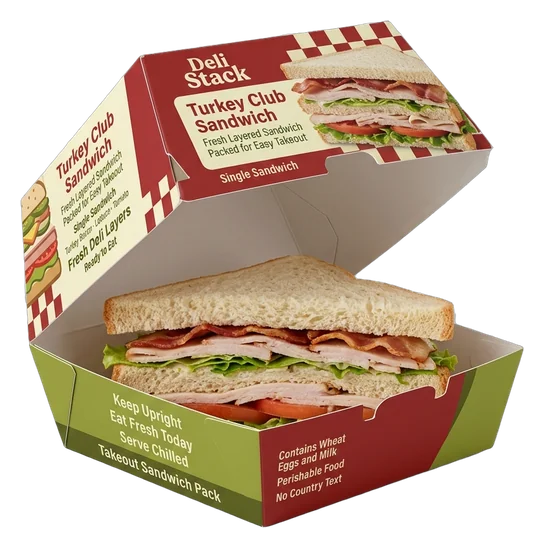
An auto-bottom structure gives sandwich packs a defined base format for orders that need a more settled foundation, while retaining useful space for menu cues and brand graphics.
- Single or meal configuration
- Auto-bottom base structure
- Full-panel brand artwork
- Counter or takeaway use
Build a more composed pack where base format and visible identity need to work together.
Customize Now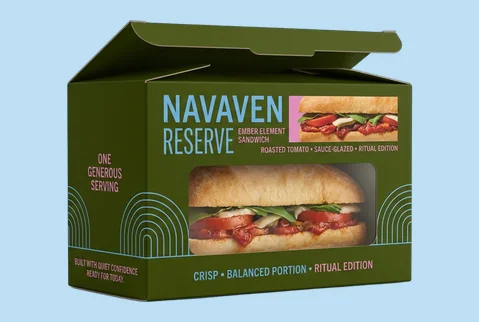
➜
Window Sandwich Boxes
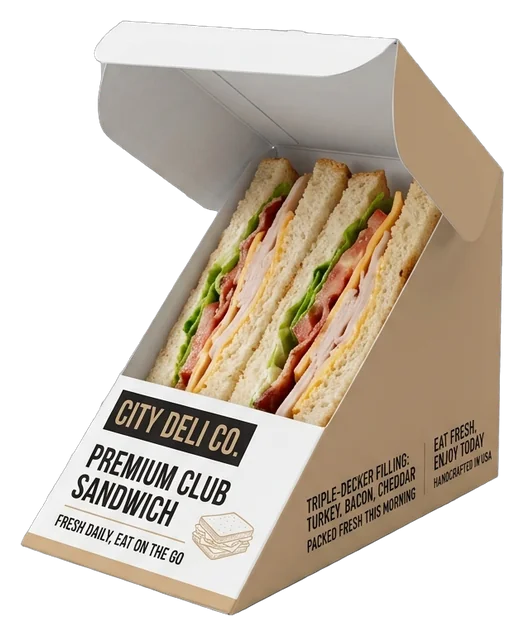
A die-cut window can place the sandwich in view while surrounding panels carry the product name, brand colors and other customer-facing information required for the chosen layout.
- Visible product area
- Custom window placement
- Printed surrounding panels
- Counter and pickup visibility
Use product visibility and printed identity together instead of asking one element to do both jobs.
Customize Now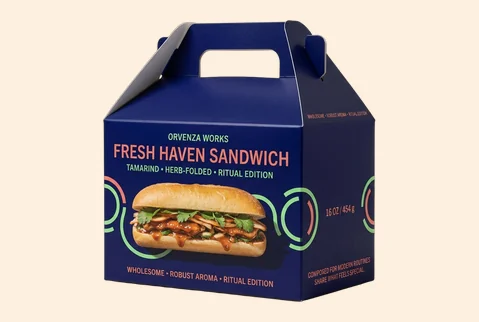
➜
Gable Sandwich Meal Boxes
A gable format creates a handled route for sandwich-and-side or selected meal configurations, with room for inserts or dividers when the approved arrangement needs clearer separation.
- Meal-set configuration
- Handled gable structure
- Printed exterior surfaces
- Handoff and takeaway use
Give a multi-part order a more deliberate arrangement and a stronger brand-owned handoff.
Customize NowMATERIAL THAT SETS THE TONE
Give Every Sandwich Box the Right Physical Character
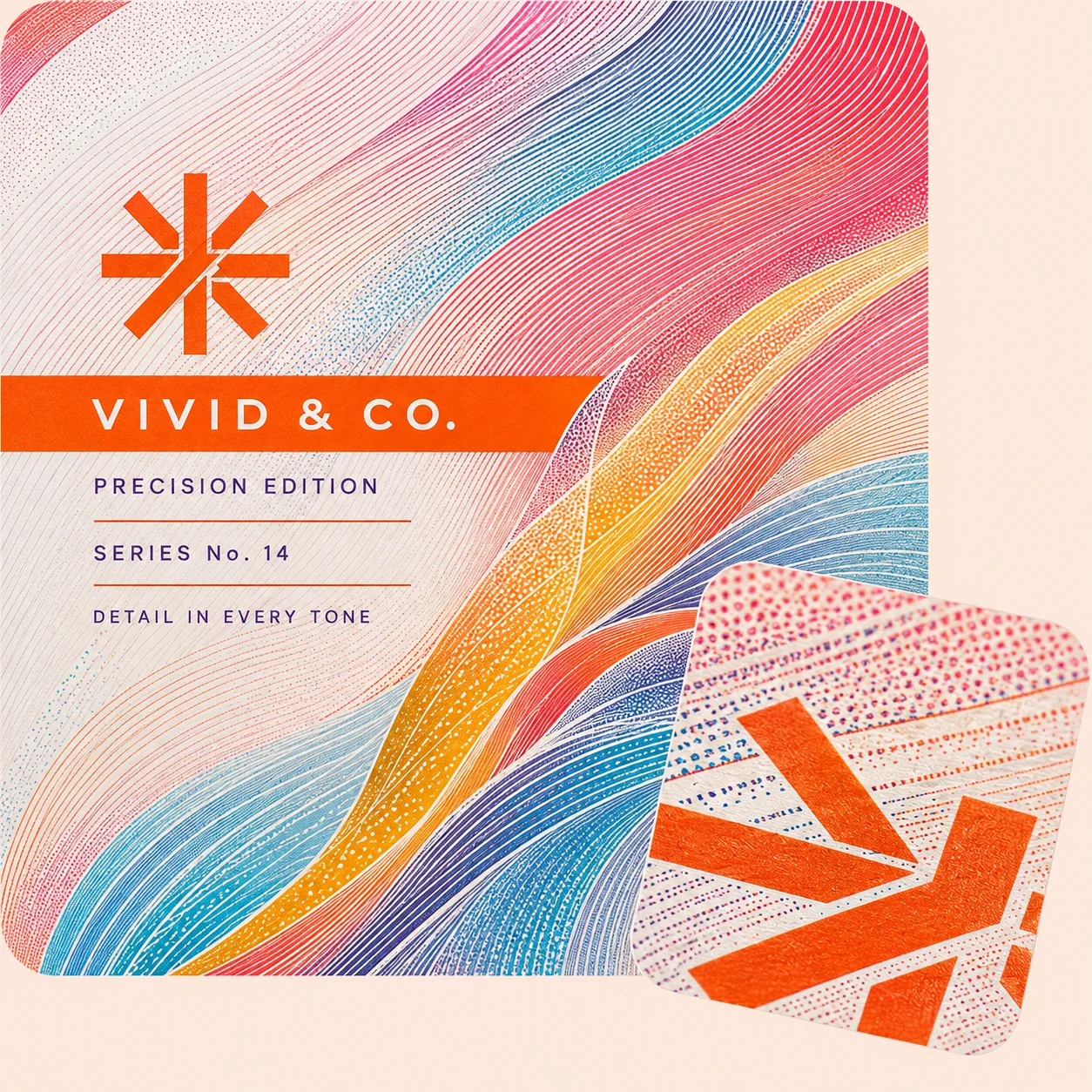
The board changes how a sandwich box feels before a customer studies the artwork. SBS paperboard gives detailed graphics and bright brand colors a smooth surface, helping counter or takeaway packs feel crisp and controlled. Kraft supports a more natural, craft-led character and pairs with white or full-color printing when that contrast fits the brand. Coated or uncoated paperboard can shift the balance between clean definition and a more tactile feel. Choose the material by the impression, contact setup and structure the order requires—not by thickness alone.
Crisp Definition on SBS Paperboard

Use SBS paperboard when clean color fields, small menu cues or detailed brand graphics need a smooth visual base. Its character supports a polished, orderly look across counter, pickup or takeaway settings.

Craft-Led Character on Kraft

Kraft gives the pack a warmer, more natural surface character. White ink, full-color printing or restrained graphics can create deliberate contrast while keeping the material visibly connected to a craft-led food identity.
Coated or Uncoated Feel

A coated surface can support a cleaner, more controlled finish, while an uncoated choice can feel more tactile and understated. Select the route that matches the brand mood and approved food-contact setup.
MENU CUES IN EVERY PANEL
Make Sandwich Choices Easy to Recognize
Customers may meet the box at the counter, on a pickup shelf or at handoff before they see the sandwich itself. Custom printing can make the product type, flavor cues and parent brand clear in that brief window. Use full-color artwork for appetite-led graphics, PMS colors for controlled brand tones, or white ink to create contrast on kraft. Carry the same visual system across the top, sides, bottom and relevant inside surfaces so individual sandwich options feel distinct without losing their connection to the wider menu. The result is a range that is easier to navigate and visibly tied to your business.
- Distinguish each sandwich variety
- Keep the menu family connected
- Lead with appetite-relevant artwork
- Extend identity across key panels
- Mark seasonal or limited menus
- Stay recognizable through handoff
FINISH WITH A FOOD PURPOSE
Guide Attention Before the Box Is Opened
A surface treatment should help customers read the sandwich box, not compete with the food or crowd the brand. Matte, gloss, soft-touch, spot UV, foil, embossing and debossing can each change what feels most important at first sight and in the hand. The right choice may calm a refined menu, sharpen a bright takeaway identity or give one name, mark or limited offer more emphasis. Use finishes selectively so the box communicates a clear quality level and keeps the visual order of the pack intact.
-
 Set the Service Mood
Matte or soft-touch treatment can give selected sandwich ranges a quieter, more considered character. Gloss can support brighter color and stronger surface clarity when the brand calls for a more energetic takeaway look. The approved material and use case should guide the choice.
-
Put the Brand Name First
Spot UV, foil, embossing or debossing can give a logo, sandwich name or key graphic more visual or tactile weight. Selective use helps direct attention without turning every printed surface into a competing focal point.
-
Give Special Menus Their Moment
A seasonal sandwich, limited menu or selected meal range can use a controlled finish contrast to feel distinct from the core offer. Keeping the underlying typography, colors and brand marks consistent preserves connection to the parent brand.


MAKE THE FIRST OPEN COUNT
Carry the Brand From Handoff to First Reveal
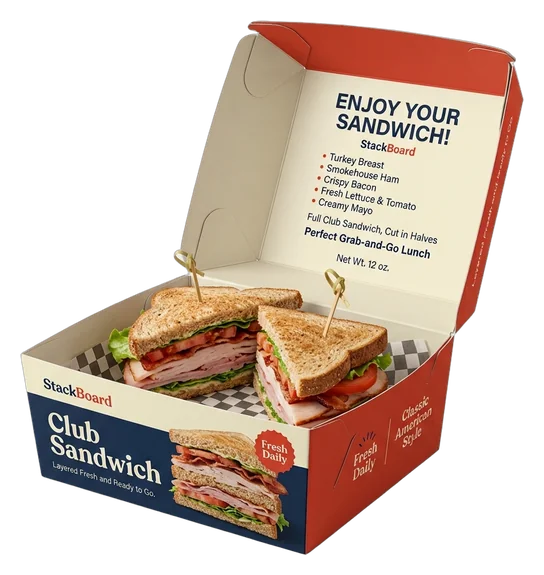
Once the customer opens a sandwich box, the outside promise should not disappear. A well-planned opening can keep the brand visible, make the sandwich easy to reach and give sides or components a deliberate place when the order uses a multi-part configuration. Relevant inside printing can continue color or short messaging, while inserts, dividers or trays can separate items where the approved structure calls for them. For a single sandwich, the right experience may be a clean, direct reveal. For a meal set, it may be a more guided arrangement. In both cases, the opening should support the way the food is served rather than add unnecessary complexity.
-
Continue Keep the Identity in View
Carry selected colors, graphics or short messaging onto relevant inside surfaces so the brand established at handoff remains visible when the box opens.
-
Guide Arrange the Order Deliberately
Use a fitted structure, insert, divider or tray when a multi-part meal needs clearer separation. The arrangement should help the customer understand the order without making access feel complicated.
-
Reward Make First Access Feel Natural
Plan which panel opens, what appears first and how the sandwich is removed. A direct, intuitive reveal can make the final service moment feel considered without implying repeated use.


EXPERT-GUIDED SANDWICH PACKAGING
Sandwich Box Customization Made Easy & Fast — Built to Hold, Separate & Present
Our sandwich packaging experts, structural designers, print specialists, consultants, and project managers make custom sandwich box ordering easy and fast by bringing your sandwich size, bread style, portion height, filling volume, wrap or liner allowance, sauce level, side-item space, closure style, display needs, selected box structure, artwork, menu labels, and restaurant brand direction into one production-ready format. We guide food-contact stock options, grease-resistant and moisture-resistant coating options, divider or insert tolerance, window placement, venting considerations, stackability, base strength, side-wall support, label-panel spacing, barcode or QR placement, dieline alignment, bleed and safe-zone setup, cost calculation, timeline planning, prepress preparation, and 3D proof review. The result is a custom sandwich box that holds portions neatly, supports better pickup, display, or delivery handling, carries your branding cleanly, and moves to production with fewer sizing, coating, print, structure, or approval risks.
-
Fast
Specs-to-Quote Alignment
Experts align sandwich size, portion height, selected box style, stock thickness, coating options, liner allowance, window needs, artwork, label areas, cost, timeline, prepress setup, and 3D proof early — helping reduce quote delays and approval back-and-forth.
-
Exact
Portion, Liner & Closure Review
We check sandwich length, bread width, filling height, sauce allowance, deli-wrap thickness, side-item space, divider spacing, closure tabs, venting needs, and stackability so the sandwich box fits the intended serving and closes more reliably.
-
Print-Ready
Moisture, Window & Print Check
Specialists review moisture-resistant coating options, grease-resistant coating options, window placement, side-wall support, label-panel spacing, QR placement, artwork alignment, coating compatibility, and safe zones so the box supports cleaner sandwich presentation and better print execution.
Plan a Sandwich Box That Fits the Food and the Service
A strong result starts before artwork is placed on the dieline. The box must be planned around the packed sandwich, the service channel, the contact setup and the way the customer will receive and open the order. Use the steps below to turn those choices into a clear production specification without guessing at dimensions or adding features that do not serve the food.
-
Measure the Sandwich as It Will Be Packed
Start with the sandwich in the condition in which it will enter the box. Provide its length, width and height, then account for any paper wrap, liner, inner container or other approved component used in the final pack. Note whether the order contains one sandwich or a multi-part meal, whether an insert or divider is needed, and how much access is required for comfortable removal. The structure should follow those inputs rather than a generic size label. The team can use them to plan the proportions, panel layout, opening direction and any window position. No fixed dimensions or clearance should be assumed until the packed product and intended arrangement are confirmed.
-
Choose the Structure Around the Handoff
Match the format to the moment in which the box must work. A tuck-end route can suit a compact single-item carton. An auto-bottom structure may be selected when the chosen pack needs that base format. A windowed box can combine product visibility with printed identification, while a gable route can support selected sandwich-and-side or meal configurations. Also explain whether the order is primarily for counter service, pickup, takeaway or a selected delivery setup. That context helps determine how much printed area, first-access guidance and internal arrangement the box needs. The approved structure should solve the service task without making the pack more complex than necessary.
-
Confirm the Board and Food-Contact Setup
SBS paperboard, kraft paperboard, coated or uncoated paperboard, and supported corrugated materials are available. For most sandwich applications, the decision should begin with the desired physical character, print result and structure. White, kraft or coated inside options can also be considered where they suit the selected specification. Food-grade paperboard and grease-resistant coating options are available, and direct-food-contact configurations can be specified. Tell the team whether the sandwich touches the board directly or remains in a wrap or liner so the material and coating can be planned for the intended use. These options must not be described as FDA-certified, and any required legal or product information supplied for print remains the buyer’s responsibility.
-
Build Artwork on the Approved Dieline
A free dieline or template can be prepared for the confirmed structure. Artwork checking, resizing, bleed and safe-zone assistance are available, and accepted production files include AI, PDF, PSD and EPS. Use the approved panel map to decide what belongs on the top, sides, bottom and relevant inside surfaces, keeping product identification and brand cues easy to find. A digital proof is available with every approved order. Review the structure, copy, colors, panel orientation and any window or finish placement before approval, because printing should not begin before the artwork is approved. The digital proof confirms the production file; it is not the same as a physical prototype.
-
Plan Quantity, Price and Production Together
Paperboard, cardstock, kraft and supported corrugated sandwich-box orders may start from 50 boxes. Relevant customization can remain available at that starting quantity when it suits the approved structure and production specification. Per-unit pricing generally improves as quantity increases, with more visible differences often appearing around 500 units; no fixed saving percentage should be assumed. Production normally takes 4–6 business days after payment, final artwork approval and structure confirmation. Production-ready jobs are generally planned to print and ship within 7 business days. Shipping transit time is separate, while complex multi-design orders may require a separately confirmed schedule. A physical prototype may be available for a qualifying bulk or wholesale project, and its cost may be adjusted into the resulting order where approved. Bring the packed-product details, intended service route, artwork and target quantity into the quote conversation together. That gives the team the information needed to recommend a box that supports the sandwich, the brand and the customer handoff as one coordinated decision.

SANDWICH BOX QUESTIONS
Answers Before You Size, Print and Order
Yes. The box can be planned around the sandwich as it will be packed, rather than around a guessed standard size. Share the packed length, width and height, along with any wrap, liner or inner container. Also note whether the order contains one sandwich or additional components, and whether a divider or insert is needed. Those details guide the proportions, opening direction, panel layout and removal clearance. Exact dimensions should be confirmed only after the full packed configuration is understood.
The right choice depends on the packed product and the handoff. A tuck-end format can provide a compact route for a single sandwich, an auto-bottom box can use that base structure where it suits the pack, and a gable format can support selected meal configurations. A windowed route may be useful when product visibility matters. Share whether the box is for counter service, pickup, takeaway or a selected delivery setup so the structure can be matched to the service moment.
Yes. A die-cut window can be positioned as one part of the panel system, leaving the surrounding surfaces available for the sandwich name, brand colors, logo and other customer-facing information. Window patching is also available. The final placement should follow the box dimensions, artwork hierarchy and intended food-contact setup, so visibility does not crowd the printed message or interfere with the approved structure.
Yes. Relevant inside surfaces can carry color, artwork or short messaging so the identity remains visible when the box opens. For a multi-part meal, supported inserts, dividers or trays can give the sandwich and other components a more deliberate arrangement where the approved structure calls for it. A single sandwich may need only a clean, direct reveal; extra interior features should be used only when they improve the actual serving and opening experience.
Yes. Food-grade paperboard and grease-resistant coating options are available, and direct-food-contact configurations can be specified. Tell the team whether the sandwich will touch the board directly or remain inside a wrap, liner or inner container so the material and coating can be planned for that use. These options should not be presented as FDA-certified, and any legally required food or product information supplied for printing remains the buyer’s responsibility.
Yes. Paperboard, cardstock, kraft and supported corrugated sandwich-box orders may start from 50 boxes, without automatically removing relevant customization choices. Subject to the approved structure and production specification, a smaller run can still use custom sizing, outside or inside printing, suitable finishes, windows, inserts or dividers. This gives an emerging food business a manageable way to establish its own package character instead of relying on a generic stock look.
AI, PDF, PSD and EPS files are accepted, and help is available with a free dieline or template, artwork checking, resizing, bleed and safe zones. A digital proof is provided with every approved order so you can review the structure, copy, panel orientation and placement of windows or finishes before printing. The digital proof is a production-file approval, not a physical prototype, and production should not begin until the artwork is approved.
Production normally takes 4–6 business days after payment, final artwork approval and structure confirmation. Production-ready jobs are generally planned to print and ship within 7 business days, but this is not a guaranteed delivery date. Shipping transit time is separate, and complex multi-design orders may need a separately confirmed schedule. Providing final artwork and structure decisions promptly helps keep the job ready for production planning.
CUSTOMER SUCCESS STORIES
Hear What Our Customers Say
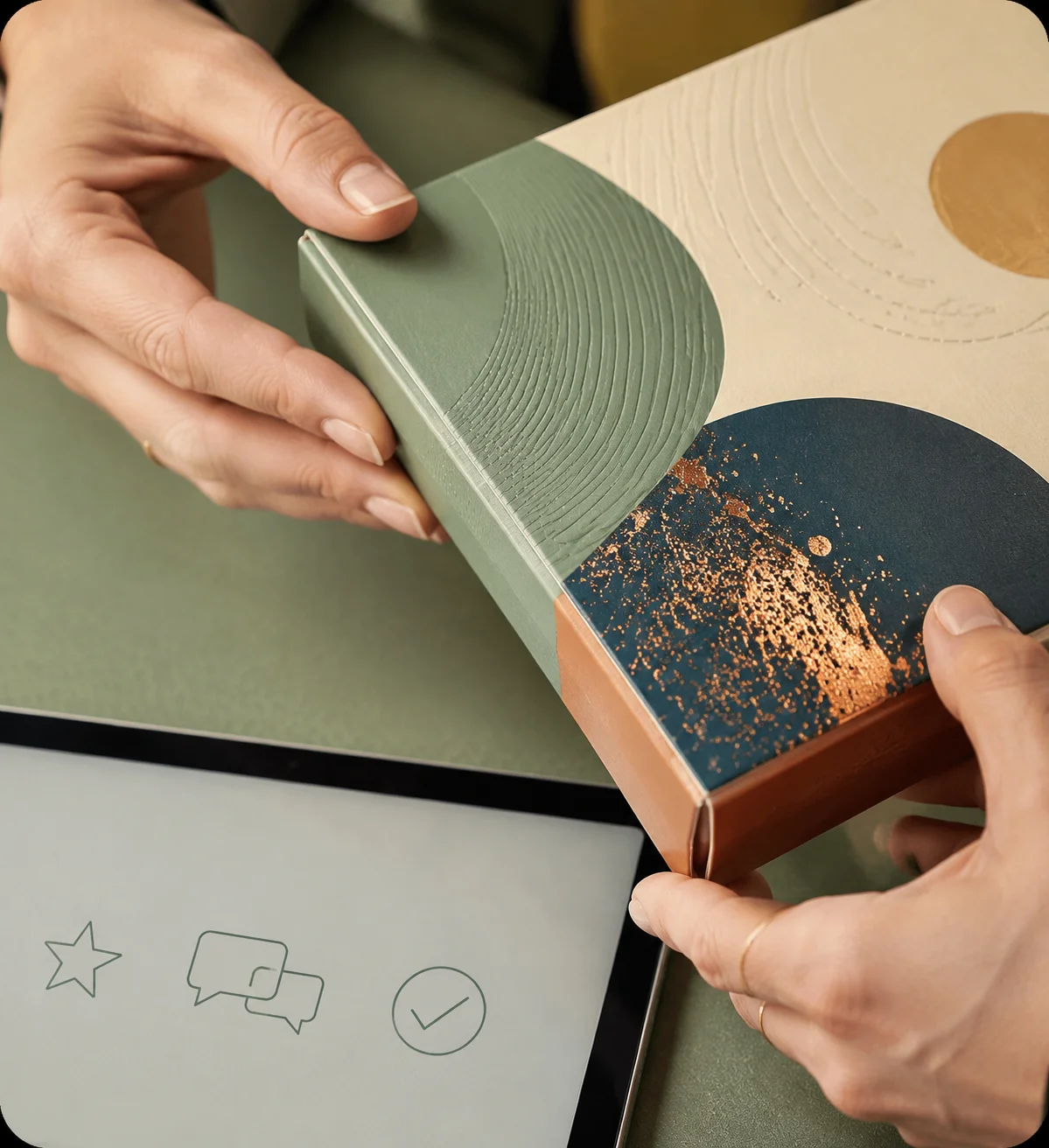

As a small business, finding premium finishes in lower quantities was always difficult. Global Custom Packaging gave us the freedom to customize our boxes and create the distinctive, polished look we wanted without committing to a large order. We still work with them today and have expanded into multiple product variants, each with the same impressive presentation.
Jordan Blake
We sell online and in stores while regularly promoting at major events, running influencer campaigns, and launching seasonal collections. Global Custom Packaging has become our dependable source for everything—from premium mailer and product boxes to sturdy influencer kits, rigid packaging, kraft boxes, and limited-edition Christmas designs. Whatever structure, material, or branded look we need, we no longer have to go anywhere else.
Avery Quinn

I never worry about how my packaging will look or whether my artwork contains typos, incorrect bleed areas, or other design errors. Their 3D previews and helpful design support give me confidence before printing. If the team notices a problem, they contact me, correct it quickly, and never charge extra for the assistance.
Cameron Reese
I’m really impressed with Global Custom Packaging’s precise, richly saturated printing and the accuracy of their die-cutting. The boxes were produced in exactly the right size, with a clean, well-formed structure and no fitting or construction issues. The finished packaging looked polished, consistent, and ready to represent our products professionally.
Morgan Taylor
I received my quote within a few hours, and once we agreed on the price, the designer responded quickly, completed the required changes, and prepared my artwork for printing. The 3D proof arrived promptly, allowing me to review everything and place my order that same day. My packaging was delivered on time, exactly as Global Custom Packaging had committed.
Harper Lane
