

Complete Guide to Game Box Packaging: The Do's & Don'ts
 Global Custom Packaging
 2026-02-23 06:07
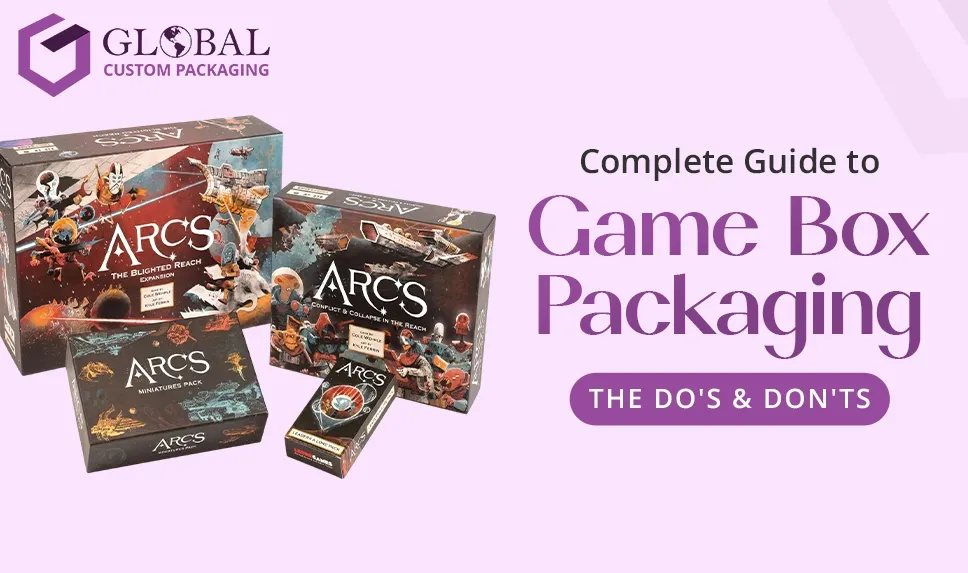
Board games have always been a way to bring people together, and traditionally, buyers focused on buying more relatable or well-known games, but now the consumers are moving towards purchasing the games that are relatively new and have eye-catching packaging.
Kids especially pick up the game box packaging that is colourful, has an amazing texture, or simply has an attractive game avatar printed on it. As the market is growing rapidly, the innovation in packaging is also crossing all horizons.
Here is an amazing fact for you: the global video game packaging market was valued at around USD 3.5 billion in the year 2024, while it's predicted to grow at about a 4.8% annual growth rate and forecasted to reach around USD 5.2 billion by the year 2033. While the board game sector stood at around USD 1.25 billion in the year 2024.
In this blog, we are going to share a complete guideline about the design of customized game box packaging and the dos & don'ts that you should keep an eye on, and why vibrant packaging matters to consumers in 2026. Let's get started!
The Importance of Game Box Packaging
The importance of game box packaging encompasses far more than aesthetics. In the packaging industry, visual appeal is responsible for driving customers to make a purchase, and box packaging serves as a powerful marketing tool. A thoughtfully designed and well-packaged game box can make a customer stop & buy the product.
Additionally, the box also plays a major role in securing the game components during the delivery process. A well-secured box will protect your game until it reaches the customers and will promote brand integrity. It not only fosters durability but also helps in increasing the perceived value of the product.
And finally, a well-packaged game can enhance the credibility of the brand and can drive customer loyalty in the long run. If you are planning to launch a game line, a cohesive visual identity can play a big role. Customers can recognise the pattern & design of the series and make an instant purchase.
Understanding Your Target Audience
Conducting market research and analysing similar games in your niche can provide valuable insights into your audience’s preferences. This information will help you make informed decisions about your packaging design that resonate with potential buyers.
1. Age Range
Take into account the age group of your customers. Are they little kids or adults, or is it a family-oriented game that should incorporate all ages?
2 Theme Choices
What style or genre will appeal to your customers more?
3. Purchase Motivation
Be conscious of your audience choices. Are they looking for educational content, strategic challenges, or a simple, quick time-pass game?
Types of boxes
Traditionally, manufacturers and brands were stuck with rectangular or square boxes due to their practicality & streamlined design. These boxes are generally crafted using corrugated material and sturdy cardboard and offer 360 degrees of protection to the components.
Regardless, with changing times, customers now want something extra, and your brand could find it hard to find loyal customers with simple packaging. Here is a list of boxes that you can select from:
1. Tuck Boxes
These are the most budget-friendly boxes. They are minimalist and limited in size and durability, and are not suitable enough to protect large board games.
2. Two-Piece Boxes
They are cost-effective, visually appealing, and functional. They are also easily stackable, along with being versatile, and have enough space to accommodate most games and can easily be stored.
3. Magnetic Lid Boxes
They are high-cost and fall under the luxury segment. They enhance customers' unboxing experience, have a robust design, and provide an aesthetic feel. They are suitable for high-end games or limited editions.
Designing Custom Game Box Packaging: The Dos & Don'ts
Following is a list of the points that you should consider before designing any game box packaging:
1. Printing on the Front and the Back
You should always include information on the front side of the box; if your game is specifically player-focused, then add details about the number of players required for the game, the age range, and instructions on how to play the game.
If these details don't fit on the front side, place them on the back side. An additional tip: add the legal information or disclaimer on the side of the box.
2. Depth & Inserts
Avoid making the box too tall or too thin in depth so that it can be easy for the retailers to stack them. You can also add foam, plastic or cardboard inserts to create partitions or for added protection and even to provide a startling unboxing experience!
3. Special Print Add-Ons
Little embellishments or extra glossy & glittery prints can add extra appeal to your designs. Always opt for a print that complements the theme of the game while boosting its overall aesthetics.
When it comes to adding an extra touch, it might be difficult for you to select the best option. Keep in mind that you have to attract the customer without avoiding the main theme of your game series! Here are two print finishes that you can choose from.
Spot UV:This finishing technique adds a clear, shiny coating to specific areas of the game box to create an eye-catching contrast.
Foil Stamping:It is a print finishing technique done by using machinery; the machine applies pigmented or metallic foil to the surface of the box using heated dye.
The Don'ts
1. Excessively Detailed Designs
A box should always be stylish, informational, and minimalist; never go overboard and make it overcomplicated.
Overly complex designs can reduce the effectiveness of the packaging box and make potential buyers choose other games over your game because of the complexity.
In a retail store, consumers usually need quick information and clarity for immediate purchase.
Elaborate textures, highly intricate graphic elements, or too many vibrant colours can make customers overwhelmed and second-guess buying your product. Impressive packaging design fosters clarity & simplicity over an excessively decorated outlook.
2. Neglecting Brand Consistency
Brand consistency among your product designs is vital for your brand to stand out and be recognisable in a marketplace where there are tonnes of options to choose from.
When logos are placed in different positions, or typography differs, or colour shifts from the product line, it can weaken the brand’s integrity.
People rely on visuals to remember or buy from the same company by looking at the packaging itself. A well-designed game box ensures brand consistency, including the same iconography, layout structure & colour scheme.
3. Skipping Testing & Prototype
If your brand bypasses the trial & testing phase or does not initially develop prototypes before full production, then it increases the chances of costly errors. Colour inconsistency, incorrect measurements & structural weakness & misaligned inserts can only become apparent after testing and developing prototypes.
Without proper assessments and going through drop tests, manufacturers can risk their investment in flawed units. Prototyping might allow designers to rectify any issues before the official launch.
The Takeaway
The packaging box of a board game is an essential element for making the product successful in the market, as it is a marketing tool that helps potential customers to finalize their purchase. Whether it comes in a sturdy rectangular box or a lid box, each type of game box packaging has its own charm that attracts the buyer to appeal to it.
As the industry is evolving quickly, the packaging is becoming a more powerful tool to captivate gamers. At Global Custom Packaging, we have a variety of completely customizable game boxes! You can check them outhere.
Thank you for reading our blog!


