-
Low Starting Quantity
-
Digital Proof Included
-
Design Support Available
-
In-House Production
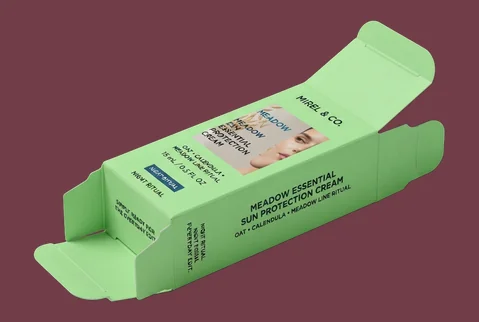
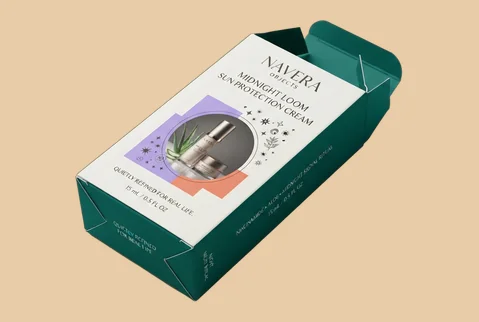
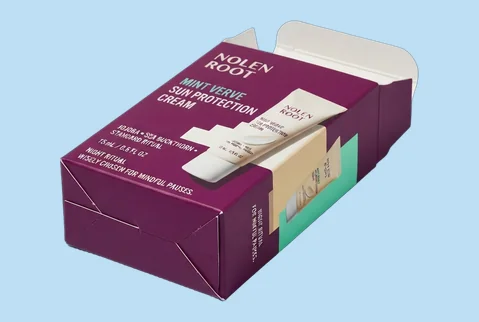
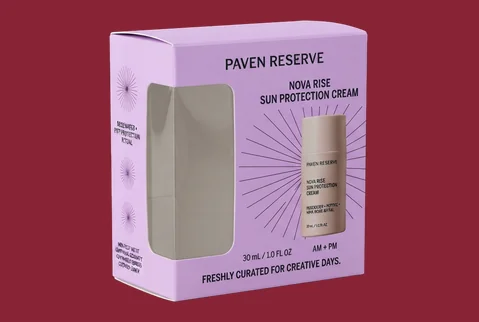
Give sun protection creams a box that makes the formula, brand character and product range easier to understand at first sight and more satisfying to receive. Sun-care buyers often compare several formulas, SPF levels, skin benefits and pack sizes in a brief retail or online decision. Custom sun protection cream boxes turn that crowded information into a clear visual order. Coordinated color, typography, material feel and structure can help a tube, jar or pump look deliberately connected to its range. That clarity supports shelf comparison, product photography, influencer seeding, gifting and direct-to-customer arrival without making unsupported performance claims. Our packaging team helps you build the box around the filled container, the selling channel and the impression your brand needs to create. Whether the direction is clinical, outdoorsy, family-friendly, mineral-led or beauty-focused, we shape the structure and surface so the pack feels considered rather than generic. The result is a more coherent product introduction from first view to first opening. That promise is supported by practical production choices: custom sizing for tubes, jars and bottles; paperboard, kraft, rigid or suitable corrugated formats; exterior and interior printing; color matching; selective finishes; windows and fitted inserts where useful. Dieline support, artwork checking and a digital proof help resolve details before production, while low starting quantities make meaningful customization accessible to both growing brands and established ranges.
Get Custom Quote
SUNSCREEN BOX FORMATS
Choose a Structure That Frames the Product Clearly
A sun protection cream box should reflect the container it holds and the way customers will meet it. A slim tube sold on a retail shelf needs different access, panel space and bottom support from a glass jar, pump bottle or coordinated sun-care set. The structure also affects how much room is available for product information, how neatly the container sits and what customers see when the box opens. We help you compare practical carton, tray, window and presentation formats so the final choice supports the product instead of adding unnecessary packaging.
Straight Tuck Cartons
Straight tuck cartons give tubes, slim bottles and lightweight containers a clean profile with top and bottom closures aligned on the same side. Their balanced panels provide useful space for brand recognition, directions and product information.
- Suits tubes and slim bottles
- Clean top-to-bottom alignment
- Broad exterior printing space
- Useful for retail display
A straightforward structure for ranges that need efficient packing, clear communication and a consistent shelf-facing appearance.
Customize Now
Reverse Tuck Cartons
Reverse tuck cartons place the top and bottom closures on opposite sides. They are well suited to everyday sun-care products where efficient production, convenient packing and a clear branded front panel are more important than an elaborate opening sequence.
- Fits common cream containers
- Efficient folding carton structure
- Clear front-panel branding
- Practical for growing ranges
A dependable option for building a coordinated product family across different formulas, SPF levels or container sizes.
Customize Now
Auto-Bottom Cartons
Auto-bottom cartons arrive with a pre-glued base that opens into position during assembly. The added bottom support can suit heavier cream jars, pump bottles or bundled products that need more stability than a standard tuck carton provides.
- Supports heavier filled containers
- Faster base setup
- Room for custom inserts
- Suitable for retail handling
This structure combines a more secure base with the printed space needed to explain and differentiate the product clearly.
Customize Now
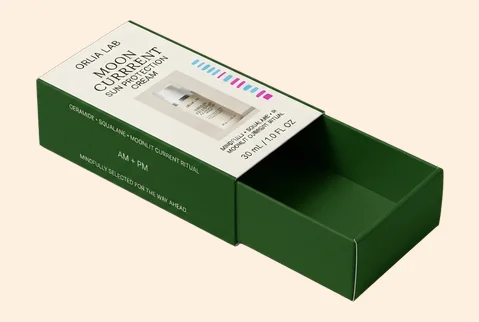
Sleeve and Tray Boxes
A printed sleeve and sliding tray can turn a skincare launch, travel set or coordinated sun-care collection into a more deliberate product reveal. The tray may hold one container or an arranged group with a fitted insert.
- Single or multi-item layouts
- Controlled product arrangement
- Branding across sleeve surfaces
- Guided sliding reveal
Use this format when product discovery, gifting or campaign presentation should feel more considered than a standard folding carton.
Customize Now
Window Cartons
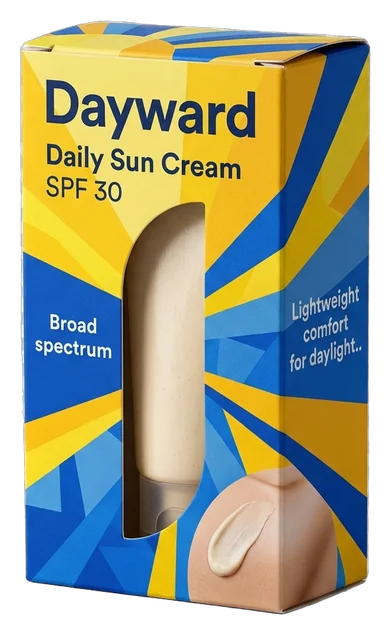
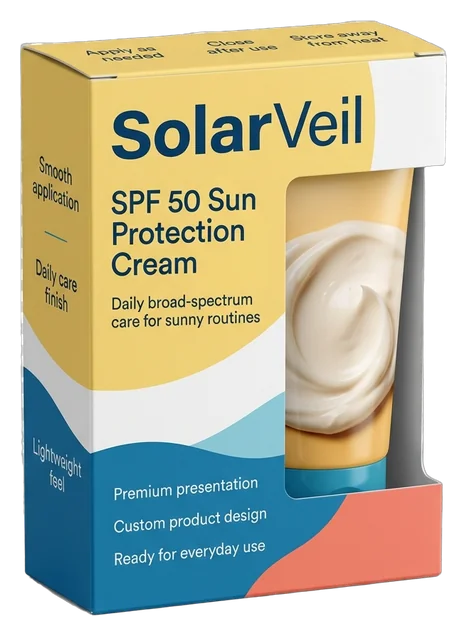
A die-cut window can reveal part of the filled tube, bottle or jar when seeing the actual container helps customers understand the product. Window size, shape and patch material should follow the container and its storage requirements.
- Shows selected container details
- Custom window shapes
- Printed or clear surrounds
- Useful for retail comparison
A window can connect the outer artwork to the real product while keeping the overall box visually controlled.
Customize Now
Rigid Sun-Care Set Boxes
Rigid boxes give launch collections, PR sets, gift assortments and higher-value skincare kits greater physical presence. A lid-and-base, magnetic or drawer-style structure can be paired with foam or paper-based inserts for an organized arrangement.
- Built for coordinated sets
- Fitted insert possibilities
- Exterior and interior branding
- Suits gifting and PR kits
Choose rigid construction when the box must introduce several products as one connected brand experience.
Customize NowMATERIALS THAT SET THE TONE
Give Every Formula the Right Physical Character
The board creates an impression before customers study the artwork. Smooth paperboard can support the clean definition expected from beauty, pharmacy-inspired or dermatologist-positioned ranges. Kraft can introduce a warmer, more natural or outdoor character, while rigid greyboard can give launch sets and gifting formats greater physical presence. Corrugated material can continue the same identity through selected ecommerce, subscription or promotional mailer formats. The right choice depends on the filled container, box size, selling channel and intended brand character—not on choosing the thickest material available.
SBS Paperboard for Clean Definition
Smooth SBS paperboard supports detailed graphics, controlled colors and small product information with strong print clarity. It works well for sun protection creams positioned around skincare routines, family use, beauty, sport or professional-looking daily protection. The even surface helps typography, ingredient panels and variant colors remain clear across a coordinated range. Board weight can then be selected according to the container, panel dimensions and required structure.
Kraft for Natural or Outdoor Character
Kraft can help mineral-led, adventure-focused, botanical or naturally styled sun-care products communicate a warmer and less clinical identity. Its visible paper character becomes part of the brand rather than disappearing beneath the artwork. Dark inks, restrained color systems and high-quality white printing can create strong contrast on kraft. The result can feel practical and distinctive without relying on unsupported environmental claims.
Rigid Greyboard for Sets and Launches
Rigid greyboard gives gift sets, PR packages, influencer kits and coordinated sun-care collections a more substantial hand feel. Wrapped exterior papers, printed liners and fitted inserts allow several products to appear as one deliberate range. This material route is most useful when the box must carry value beyond simple containment, such as a launch moment, campaign handoff or curated seasonal set.
Corrugated Material for Branded Arrival
Supported corrugated formats can carry the brand into promotional mailers, ecommerce kits and direct-to-customer sun-care sets. The fluted construction provides more physical support while printed surfaces keep the arrival connected to the retail or online identity. This route is intended for product, presentation and mailer applications rather than large commodity shipping cartons. Structure and size should be confirmed around the actual products and delivery plan.
FORMULA, SPF & BRAND IN VIEW
Make Each Sun-Care Variant Easy to Recognize
A customer may need to distinguish a face cream from a body formula, a mineral product from another formulation, or one SPF level from the next within seconds. Custom printing can turn those differences into a clear range system while keeping the parent brand recognizable. Use color, typography, product names, icons and panel organization to show how each item fits within the collection. CMYK, PMS or spot colors, white ink on kraft and printing across outside or inside surfaces provide the production freedom; the useful outcome is a range that feels connected without making every product look identical.
- Give each formula a clear identity
- Keep SPF variants visibly connected
- Separate face, body and family ranges
- Organize directions and product information
- Continue selected brand cues inside
- Stay recognizable across chosen channels
Full-color printing can support photography, gradients, illustrated skin-care stories or active outdoor scenes. Spot colors can help maintain controlled brand shades across several products, while white ink can give kraft packaging clearer contrast. Printing can extend across the front, back, top, bottom, sides and selected interior surfaces. The artwork should use those areas as one connected information system rather than treating every panel as an unrelated advertising space.
Get Instant Quote➜SURFACE CUES WITH A JOB
Direct Attention Without Overworking the Pack
Sun protection cream packaging often needs to communicate several ideas at once: daily care, product type, SPF level, skin suitability and brand personality. Finishes should help customers find the most important cues instead of making the surface busier. A matte or soft-touch treatment can create a calmer skincare character. Gloss can strengthen bright outdoor artwork, while foil, embossing or raised spot effects can give selected brand elements more weight. Each finish should earn its place by controlling attention, hand feel or edition value.
-
Establish the Overall Surface Mood
Matte lamination can support a clean, understated or mineral-led identity. Soft-touch can make a beauty-focused or facial sun-care line feel more considered in the hand. Gloss may suit energetic family, sport, beach or children’s ranges that use brighter color and sharper visual contrast. The choice should follow the brand character and handling environment rather than a general assumption that one finish always appears more expensive.
-
Make Important Cues Easier to Notice
Foil stamping, embossing, debossing, spot UV or raised effects can give the brand name, product family or selected design feature stronger visual and tactile priority. Gold, silver, rose-gold, colored foil and raised treatments can be considered where they suit the approved artwork. The goal is to direct attention to a few meaningful elements, not to decorate every available panel.
-
Separate Campaigns and Special Sets
Travel collections, summer campaigns, gift sets, launch kits and limited-edition collaborations can use selective surface contrast to feel different from the core range. A changed foil shade, textured logo, gloss detail or embossed campaign mark can create distinction while the main color and typography system preserves parent-brand continuity. This helps special editions feel intentional without making them appear unrelated to the products customers already recognize.
MAKE THE FIRST OPENING COUNT
Carry Brand Confidence Into the First Reveal
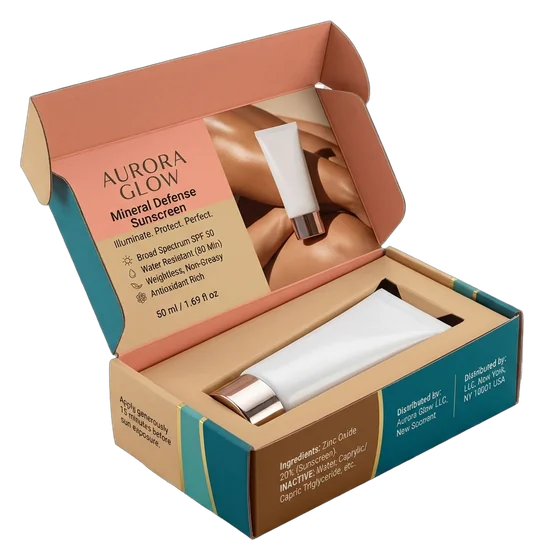
A clear exterior sets an expectation about the formula and brand, but the first opening should confirm that expectation rather than interrupt it. For a single tube or bottle, this may simply mean clean access, an orderly interior and a container that does not appear lost inside an oversized carton. For travel kits, skincare routines, PR packages or coordinated SPF collections, the interior may need to organize several products and explain how they relate. Interior printing, trays, dividers and fitted inserts should support that discovery instead of being added only for decoration.
-
Keep the Brand Present
Carry selected colors, patterns or short messaging onto an inside flap, tray or liner so the identity remains visible after the exterior opens. Interior printing can support a care instruction, campaign line or simple welcome without crowding the first reveal. The inside does not need to repeat the complete outer design. A controlled continuation often feels clearer and more intentional.
-
Give Every Product a Defined Place
Use paperboard, kraft, corrugated, cardboard or foam inserts to position tubes, jars, applicators and supporting products within a set. Consider the number of items, container profiles, pack orientation and removal clearance before choosing the insert. A deliberate arrangement helps customers understand the collection and reduces the loose, improvised feeling that can weaken a carefully designed exterior.
-
Control What Customers Discover First
A sleeve, tray, lid-and-base box or fitted kit can determine whether customers first see the hero product, the complete routine or a printed message. This is particularly useful for influencer seeding, gifting, travel collections and seasonal skincare launches. The purpose is not to create unnecessary theatre. It is to make the opening order support the same product story that earned attention on the outside.
Plan the Box, Artwork and Order With Confidence
A useful sun protection cream box starts with practical decisions that are settled before printing. The steps below help you define the fit, choose a structure for the sales channel, prepare suitable artwork and plan production without relying on guessed dimensions or vague packaging specifications.
-
Start With the Filled Container
Size the box from the actual tube, jar, pump bottle or applicator that will be packed. Share its length, width and height, along with cap shape, shoulder profile, wrapping, labels and any protruding pump or nozzle. For sets, also provide the number of items, preferred arrangement and the clearance needed to lift each product out without forcing it. Our team can use these inputs to prepare a custom dieline rather than adapting your product to a stock carton. Paperboard is available in supported 14 pt. to 24 pt. ranges, but the final board choice should follow the container weight, panel size, opening style and intended handling—not thickness alone.
-
Match the Structure to the Selling Channel
A single retail tube may only need an efficient tuck carton with strong front-panel recognition and enough space for instructions. A heavier jar or pump may benefit from a lock-bottom or auto-bottom structure. A beauty set, launch kit or influencer mailer may need a sleeve-and-tray format, rigid setup box or branded corrugated mailer with an insert. Tell us whether the box will be displayed on a shelf, photographed for ecommerce, handed over as a promotional set or shipped as part of a direct-to-customer order. We can then recommend a configuration that supports the real journey instead of adding features that do not improve the pack.
-
Prepare Every Panel Before Approval
Plan the information hierarchy before decoration. The main panel should help shoppers identify the brand and product variant quickly. Side and back panels can hold directions, ingredients, warnings, barcode space, batch details or other required information. Only use SPF values, performance statements and regulated wording that your business is authorized to publish. The buyer remains responsible for the accuracy and legal suitability of supplied product claims and required information. Packaging production does not constitute FDA approval, medical certification or regulatory approval. We accept AI, PDF, PSD and EPS production files. Artwork support can include a free dieline or template, file checking, resizing, bleed and safe-zone help, and preparation for exterior or interior printing. Printing is available in CMYK, PMS or spot colors, digital, offset and supported flexographic routes, depending on the approved job.
-
Review the Dieline and Digital Proof
A digital proof is available for every approved order. Use it to check panel orientation, copy placement, colors, cut lines, folds, windows and finish positions before production begins. A digital proof confirms the prepared artwork; it is not the same as a physical prototype. A physical prototype may be available for a qualifying bulk or wholesale project. Where approved, its cost may be adjusted into the resulting order. No die or plate fee may apply where supported by the final production specification. Printing does not begin until payment, artwork approval and structure confirmation are complete.
-
Plan Quantity, Production and Delivery
Paperboard, cardstock, kraft and supported corrugated sun protection cream boxes may start from 50 units. Supported rigid-box formats may start from 25. These starting quantities can still include relevant custom sizing, printing, finishes and inserts, subject to the approved structure and production specification. Per-unit pricing generally improves as quantity increases, with more visible differences often appearing around 500 units. For launches with several designs, share the quantity per version so setup requirements can be scheduled correctly. Production normally takes 4–6 business days after payment, final artwork approval and structure confirmation. Production-ready jobs are generally planned to print and ship within 7 business days. Shipping transit time is separate, while complex multi-design orders may require a separately confirmed schedule. We can also plan bulk runs, ship one order to multiple addresses and support design firms or white-label workflows. Final timing should be confirmed against the chosen material, structure, number of designs and delivery plan before the job moves forward.
SUN-CARE BOX QUESTIONS
Answers Before You Size, Print and Order
Yes. Sun protection cream boxes can be sized around tubes, jars, pump bottles, applicators and other filled primary containers. Share the exact product dimensions, cap or pump profile and any label or protective wrapping that changes the outer size. We can then prepare the carton and dieline around the real container rather than relying on a general sunscreen-box size. For multi-product sets, also provide the item count, preferred arrangement and the way each product should be removed.
Yes. Each formula or SPF level can have its own color, product name, imagery and information while remaining visibly connected to the parent brand. A controlled design system can distinguish face, body, mineral, sport, family or travel products without making the collection feel fragmented. CMYK, PMS or spot colors, full exterior printing and selected interior printing are available. All SPF values, performance statements and legally required wording must be supplied and approved by the buyer.
Guidance is available based on the filled product and the way it will be sold. A tuck carton may suit a single retail tube, while an auto-bottom box can provide more support for a heavier jar or pump bottle. An ecommerce kit, subscription set or influencer package may benefit from a branded corrugated mailer, tray or rigid box with an insert. Tell us where customers will meet the product so the recommendation reflects actual display, handling, photography and opening needs.
Yes. Inserts can be designed to hold one or several tubes, bottles, jars, applicators or related skincare products in a planned arrangement. Available routes include paperboard, cardstock, kraft, corrugated, cardboard and die-cut foam. The insert is developed around the product shapes, pack count and removal clearance. This is useful for travel kits, launch collections, PR packages and gift sets where loose products would weaken the first reveal or make the range harder to understand.
Yes. A growing sun-care business can start with packaging developed around its own product and visual identity without committing to a very large first run. Paperboard, cardstock, kraft and supported corrugated boxes may start from 50 units, while supported rigid formats may start from 25. Relevant custom sizing, outside or inside printing, material choices, finishes and inserts can remain available at these starting quantities, subject to the approved structure and production specification.
Yes. A die-cut window can reveal part of the tube, cap, bottle or jar when seeing the primary container helps customers identify the product. Windows can be produced in custom shapes with appropriate patching where required. The size and position should be planned around the container, artwork and product-storage requirements. A window is most useful when it adds meaningful product recognition; it should not remove essential print space or expose more of the container than the product should show.
Yes. Free dieline or template support, artwork checking, resizing, bleed assistance and safe-zone guidance are available. AI, PDF, PSD and EPS files can be accepted for production preparation. A digital proof is provided for every approved order so you can review layout, panel direction, cut lines, folds, colors and finish placement before printing. The digital proof is not a physical prototype, and production begins only after the required payment, artwork approval and structure confirmation.
Production normally takes 4–6 business days after payment, final artwork approval and structure confirmation. Production-ready jobs are generally planned to print and ship within 7 business days. Shipping transit time is separate. Orders involving many different designs, complex setups or specially confirmed production requirements may need a separate schedule. Timing should therefore be confirmed after the material, structure, quantity, artwork versions and delivery plan have been reviewed.
A physical prototype may be available for a qualifying bulk or wholesale project. When approved, the prototype cost may be adjusted into the resulting order. This is different from the digital proof included with every approved order. A prototype is not offered as an unrestricted free sample, and one-box production is not available. Discuss the expected bulk quantity, structure and testing purpose with the packaging team so prototype eligibility and cost treatment can be confirmed.
Yes. Per-unit pricing generally improves as the order quantity increases because production setup is distributed across more boxes. More visible differences often begin around 500 units, although the exact change depends on material, size, structure, number of designs, printing coverage, finishes and inserts. Share both the total quantity and the quantity required for each artwork version. This helps the team prepare a more useful quotation and identify whether one combined run or separately scheduled versions make better production sense. The next useful pass would be converting this into the exact backend YAML or HTML fields, including card arrays, badge fields and individual FAQ objects.
CUSTOMER SUCCESS STORIES
Hear What Our Customers Say